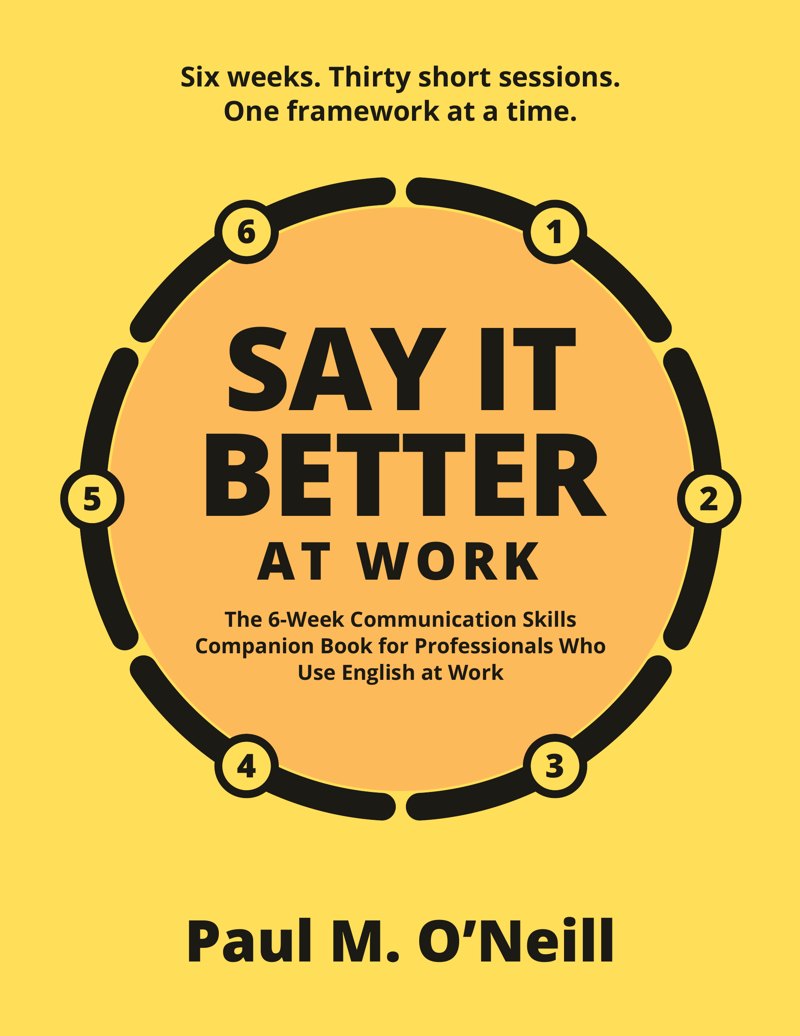
Say It Better at Work
You know what you think. So why does it come out wrong? Six weeks of short daily practice, one framework at a time, for professionals who use English at work, whether it's your first language or your second.
- 6 weeks, 30 short sessions
- 22 frameworks
- 74 free audio model answers
- Phrase banks in 3 registers
Week 1, Day 1 · The Moment
It's your second Tuesday at Calder, 10.40. The weekly project meeting is nearly over. Elena, your manager, has been talking about Friday's call with Lumen Retail for ten minutes. Tom wants to move it to Monday. Sara doesn't.
Then Elena stops, looks round the table and says your name. “What do you think?”
You know what you think. You've known for ten minutes. But the first words that come out are “Well… it depends… there are many factors…” And Elena is already looking at Sara.
What went wrong? It wasn't your English. It was your first sentence.
The missing piece
A structure. Four sentences, in the right order.
This is PREP, the first framework in Week 1. Press play: you'll hear a question, a pause to give your own answer out loud, then one way to say it.
- PPointI think we should try a no-laptops rule, at least for our Tuesday meeting.
- RReasonThat's because people are half listening while they answer emails.
- EExampleFor example, last week we spent ten minutes repeating a decision because two people had missed it.
- PPointSo yes, I'd try no-laptops for a month and see what happens.
That's one exercise from one day. The book gives you thirty days of moments like this, so the structure is there when you need it, without thinking.
Look inside
Every day follows the same steps
Fifteen to twenty minutes a day, five days a week. Learn the routine once, then put your energy into the words. Tap a page to see it full size.
A short scene at work. What would you say?
The framework, one line per letter.
Real phrases in formal, neutral and friendly English.
The same idea said three ways.
Common traps for Italian, German, French and Spanish speakers.
A weak message to improve.
Spoken practice, out loud and timed.
Prepare your words for a real situation this week.
Day 5 is your weekly review: a quiz, your Scorecard, a real moment to write about, a role-play and a challenge for the following week.
Six weeks, one skill at a time
From your first sentence to the hardest meeting
Fourteen frameworks from Say It Better, practised in real situations at work. Then eight more, beyond the book.
Free audio
Practice you hear and speak
Reading a framework is easy. Saying it under pressure is the skill. Every week has free audio model answers at sayitbetter.info/audio. Try three more from Week 1:
Watch out
The traps your first language sets for you
Some mistakes feel right because they come from your first language. Every day has Watch-out boxes for Italian, German, French and Spanish speakers. Read all four: your colleagues make these mistakes too. This one is from Week 1, Day 1.
All four“Actually” and “eventually”
Attualmente, aktuell, actuellement and actualmente mean “currently”, not “actually”. Eventualmente, eventuell, éventuellement and eventualmente mean “possibly”, not “eventually”. Say currently and possibly.
It's “I agree”, never “I am agree”.
A fact-first answer can sound blunt in English. Add a softener to your Point: “I'd suggest…” rather than “We must…”.
A long introduction before the point feels polite to you, but in English meetings it can sound unsure. Put the Point first and the context second.
Native speaker? The rest of each day works for you exactly as it is. As the book says, many of the most persuasive people speak English as a second, third or fourth language. What they have is a structure.
Is it for you?
Who this book is for
It's for you if
- You use English at work, as an upper-intermediate or advanced learner, or as a native speaker.
- You go quiet in meetings, then think of the perfect answer on the way home.
- You give feedback, say no, persuade or handle complaints, and want a structure for each.
- You want something you can use on Monday, in fifteen to twenty minutes a day.
It isn't for you if
- You're still building everyday English. Come back when meetings in English are part of your work.
- You want a grammar book or exam preparation.
- You'd rather read about communication than practise it out loud.
Teachers and coaches: you may photocopy the role-play cards, the framework cards and the “Your card” pages for use with your own learners.
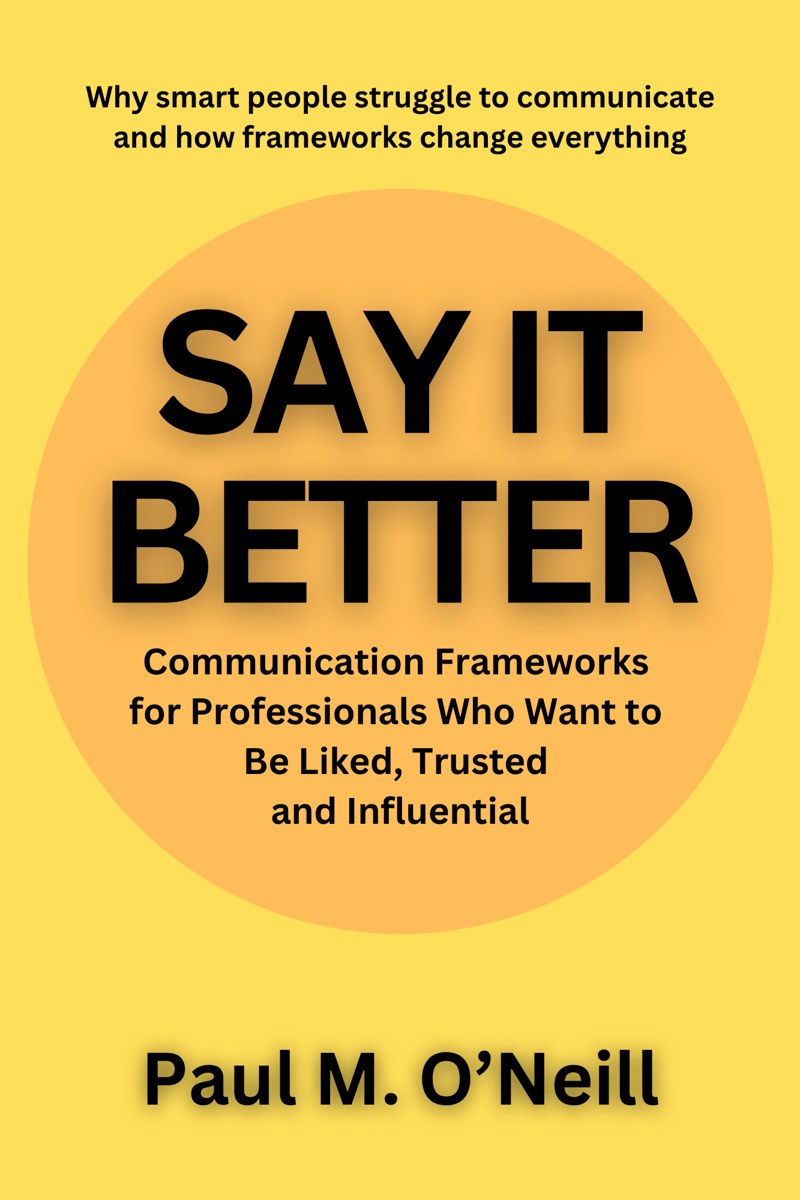
Works on its own, or alongside Say It Better
The book explains the thinking. This companion book makes it a habit.
You don't need to have read Say It Better, although it helps. Every story and example in the companion book is new.
See Say It Better on Amazon
About the author
Paul M. O'Neill
Paul is a business English coach who helps professionals communicate with clarity and confidence at work. He is the author of Say It Better: Communication Frameworks for Professionals Who Want to Be Liked, Trusted and Influential, and runs English Language Lab and the Beautiful British English YouTube channel.
Want help with a real situation at work? Book a free 30-minute session with Paul.
Questions
Before you buy
What level of English do I need?
The book is written for upper-intermediate to advanced learners, and for native speakers who want clear structures for difficult moments at work.
Do I need to read Say It Better first?
No, although it helps. Say It Better explains why each framework works. This companion book is where you practise them, with all-new stories and examples.
How much time does it take?
Fifteen to twenty minutes a day, five days a week, for six weeks. If you miss a day, don't try to catch up with three units at once. Just continue.
Is the audio really free?
Yes. The audio is free and optional, with no account. Week 1 is live now and new weeks are added as they're ready. Every exercise also works without it.
What format is the book?
A 232-page, large-format (8.5 × 11 in) colour paperback, with space to write your answers. Model answers are at the back.
Can I use it with a teacher or a partner?
Yes. There's a section on practising with a partner, a teacher or a coach, and a role-play every Day 5. Teachers may photocopy the role-play cards, framework cards and “Your card” pages for their own learners.
Free, every week
Join the Framework Series
One framework lesson a week, plus each new week's audio the day it goes live. Short, practical and written for professionals who use English at work. From Paul M. O'Neill.